 Udam Singh
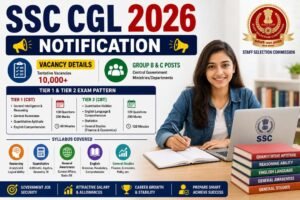
SSC CGL 2026 Notification, Vacancy Details, Tier 1 & Tier 2 Exam Pattern & Syllabus
Read Article →
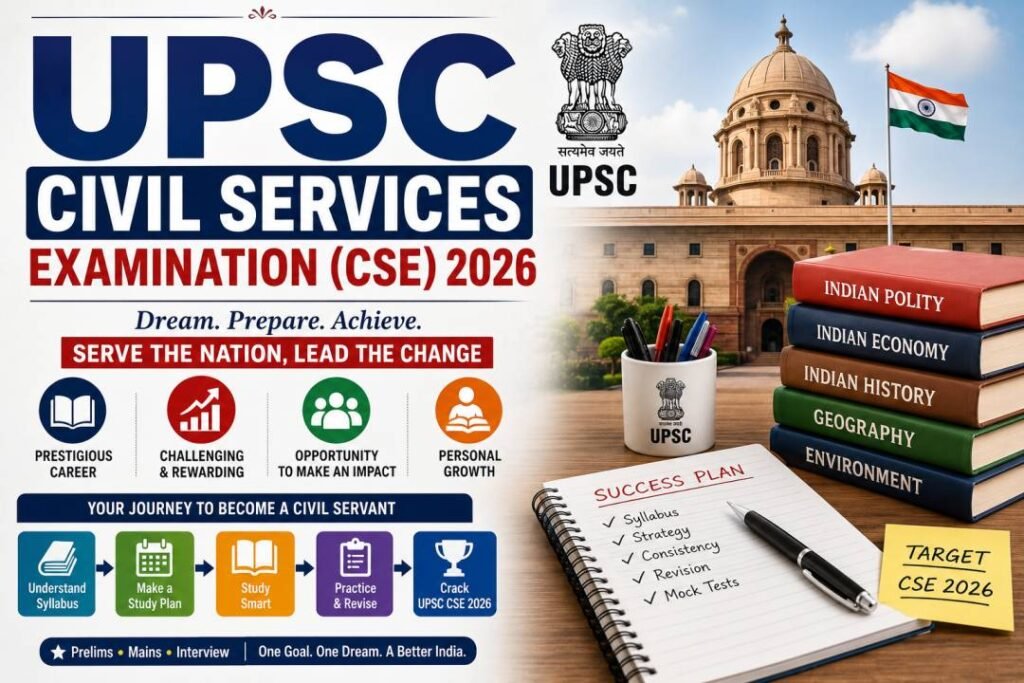
The Union Public Service Commission Civil Services Examination (UPSC CSE 2026) is India’s premier and most prestigious competitive examination, selecting administrative leaders for the Indian Administrative Service (IAS), Indian Police Service (IPS), Indian Foreign Service (IFS), Indian Revenue Service (IRS), and 20+ other Group ‘A’ and Group ‘B’ central civil services. Often hailed as one of the most intellectually rigorous examinations in the world, UPSC CSE tests analytical depth, ethical decision-making, wide-ranging general awareness, and administrative temperament.
Whether you are a fresh college graduate or an experienced professional starting your preparation in 2026, conquering UPSC CSE requires a disciplined, multi-stage strategy across Prelims (Screening), Mains (Written Merit), and the Personality Test (Interview). This comprehensive 2026 guide breaks down the eligibility criteria, examination blueprint, 9-paper Mains structure, optional subject selection strategy, and an integrated study roadmap.
UPSC CSE 2026: Examination Blueprint & Key Parameters
The table below summarizes the key recruitment parameters of the UPSC Civil Services Examination:
| Parameter | UPSC CSE 2026 Official Details |
|---|---|
| Conducting Constitutional Body | Union Public Service Commission (UPSC) |
| All India Services Recruited | IAS (Administrative), IPS (Police), IFS (Foreign), IRS (Customs/IT), IA&AS, IDAS, etc. |
| Educational Qualification | Bachelor’s Degree in any discipline from a recognized University (Final year students eligible) |
| Examination Stages | Stage 1: Preliminary Exam (CBT/OMR) → Stage 2: Mains (Descriptive Written) → Stage 3: Personality Test |
| Total Marks for Final Merit | 2025 Marks (Mains Written: 1750 Marks + Personality Test: 275 Marks) |
| Official Notification Portal | upsc.gov.in |
Category-Wise Age Limits & Permissible Number of Attempts
UPSC enforces strict attempt limits and age thresholds calculated as of August 1st of the examination year:
| Category | Minimum Age | Upper Age Limit | Permissible Number of Attempts |
|---|---|---|---|
| General / EWS | 21 Years | 32 Years | 6 Attempts |
| Other Backward Classes (OBC – Non-Creamy Layer) | 21 Years | 35 Years (3 Years Relaxation) | 9 Attempts |
| Scheduled Castes (SC) / Scheduled Tribes (ST) | 21 Years | 37 Years (5 Years Relaxation) | Unlimited Attempts (Up to age limit) |
| Persons with Benchmark Disabilities (PwBD) | 21 Years | 42 Years (10 Years Relaxation) | 9 Attempts (General/OBC) | Unlimited (SC/ST) |
Stage 1: Preliminary Examination (Prelims) Pattern
The Preliminary Examination serves as a screening filter consisting of two objective papers conducted on a single Sunday:
| Paper | Subjects Evaluated | Questions & Marks | Duration & Nature |
|---|---|---|---|
| General Studies Paper I (GS-I) | Indian History, Geography, Polity & Governance, Economy, Environment & Ecology, General Science, Current Events | 100 Questions (200 Marks, 2 Marks/Q) | 2 Hours (Cutoff-deciding paper; 0.66 negative marking) |
| General Studies Paper II (CSAT) | Reading Comprehension, Logical Reasoning, Analytical Ability, Basic Numeracy (Class 10 level), Data Interpretation | 80 Questions (200 Marks, 2.5 Marks/Q) | 2 Hours (Qualifying nature; mandatory 33% = 66 Marks required) |
Stage 2: Main Examination (Mains Written – 1750 Marks)
The written Mains Examination consists of 9 conventional essay-type papers conducted over 5 days. Papers A and B are qualifying, while the remaining 7 papers determine the final merit rank:
| Paper Code | Subject Title | Maximum Marks | Merit Status |
|---|---|---|---|
| Paper A | One Indian Language (from 8th Schedule of Constitution) | 300 Marks | Qualifying (25% = 75 Marks required) |
| Paper B | English Language | 300 Marks | Qualifying (25% = 75 Marks required) |
| Paper I | Essay (2 Essays on Philosophical / Socio-Economic Themes) | 250 Marks | Counted for Merit |
| Paper II | General Studies I (Indian Heritage, Culture, History, Geography, Society) | 250 Marks | Counted for Merit |
| Paper III | General Studies II (Governance, Constitution, Polity, Social Justice, IR) | 250 Marks | Counted for Merit |
| Paper IV | General Studies III (Technology, Economic Development, Biodiversity, Security, Disaster Mgmt) | 250 Marks | Counted for Merit |
| Paper V | General Studies IV (Ethics, Integrity, and Aptitude + Case Studies) | 250 Marks | Counted for Merit |
| Paper VI & VII | Optional Subject – Paper 1 & Paper 2 (Chosen from 26+ Optional Disciplines) | 250 + 250 = 500 Marks | Counted for Merit |
Stage 3: Personality Test & Interview (275 Marks)
The Personality Test is an objective assessment conducted by a board of seasoned administrators, diplomats, and academicians at Dholpur House in New Delhi. The interview evaluates:
- Mental Alertness & Critical Assimilation: Ability to analyze complex administrative and geopolitical dilemmas objectively without ideological bias.
- Balance of Judgement: Capacity to weigh constitutional principles, social welfare, and economic viability when solving public policy problems.
- Integrity & Moral Dimension: Demonstrated ethical clarity, empathy for marginalized communities, and leadership stability under interrogation pressure.
Integrated 12-Month Preparation Strategy for UPSC 2026
- Months 1–4 (NCERT Foundations & Optional Subject): Read Class 6–12 NCERT textbooks in History, Geography, Polity, and Economics. Complete 70% of your chosen Optional Subject syllabus and prepare concise, one-page revision notes.
- Months 5–8 (Standard Reference Texts & Answer Writing): Read core standard references (Laxmikanth for Polity, Spectrum for Modern History, Shankar IAS / PMF IAS for Environment, Ramesh Singh for Economy). Begin daily answer writing (2 questions per day from previous years’ papers).
- Months 9–10 (Ethics & Essay Mastery): Practice 30+ ethics case studies focusing on constitutional values, ethical dilemmas, and administrative problem-solving. Write one full 250-mark Essay test every alternate Sunday.
- Months 11–12 (Prelims-Exclusive Mock Drills): Shift 100% of study time to Prelims-oriented MCQs and CSAT practice. Attempt a minimum of 40 full-length GS-1 test series and 15 CSAT mock tests.
Frequently Asked Questions (FAQs)
1. Does an attempt in the UPSC Prelims count towards the attempt limit?
Yes. If a candidate appears in any one paper of the Preliminary Examination (GS-I or CSAT), it is officially deemed that the candidate has made an attempt at the examination.
2. Which optional subject has the highest scoring potential?
Popular and consistently high-scoring optionals include Political Science & International Relations (PSIR), Sociology, Anthropology, Geography, Public Administration, and Literature subjects (Hindi/Tamil/Telugu/Malayalam/Kannada).
3. What is the minimum educational cutoff percentage required to apply for UPSC?
There is no minimum percentage requirement in graduation. Any graduate with a simple passing degree from a recognized university is eligible to appear for UPSC CSE.
4. How is cadre allocation decided for IAS and IPS?
Cadre allocation is determined using the 5-zone preference policy based on the candidate’s All India Rank, category vacancy matrix, and submitted preference order.